Free US shipping over $5030-day money-back guaranteeEvery batch third-party tested

Methylene blue, explained.

A pharmaceutical-grade compound, prepared as a 1% solution and measured by the drop. Here is what it is, how it is dosed, and what to know before you take it.

See Methylene Blue 1%
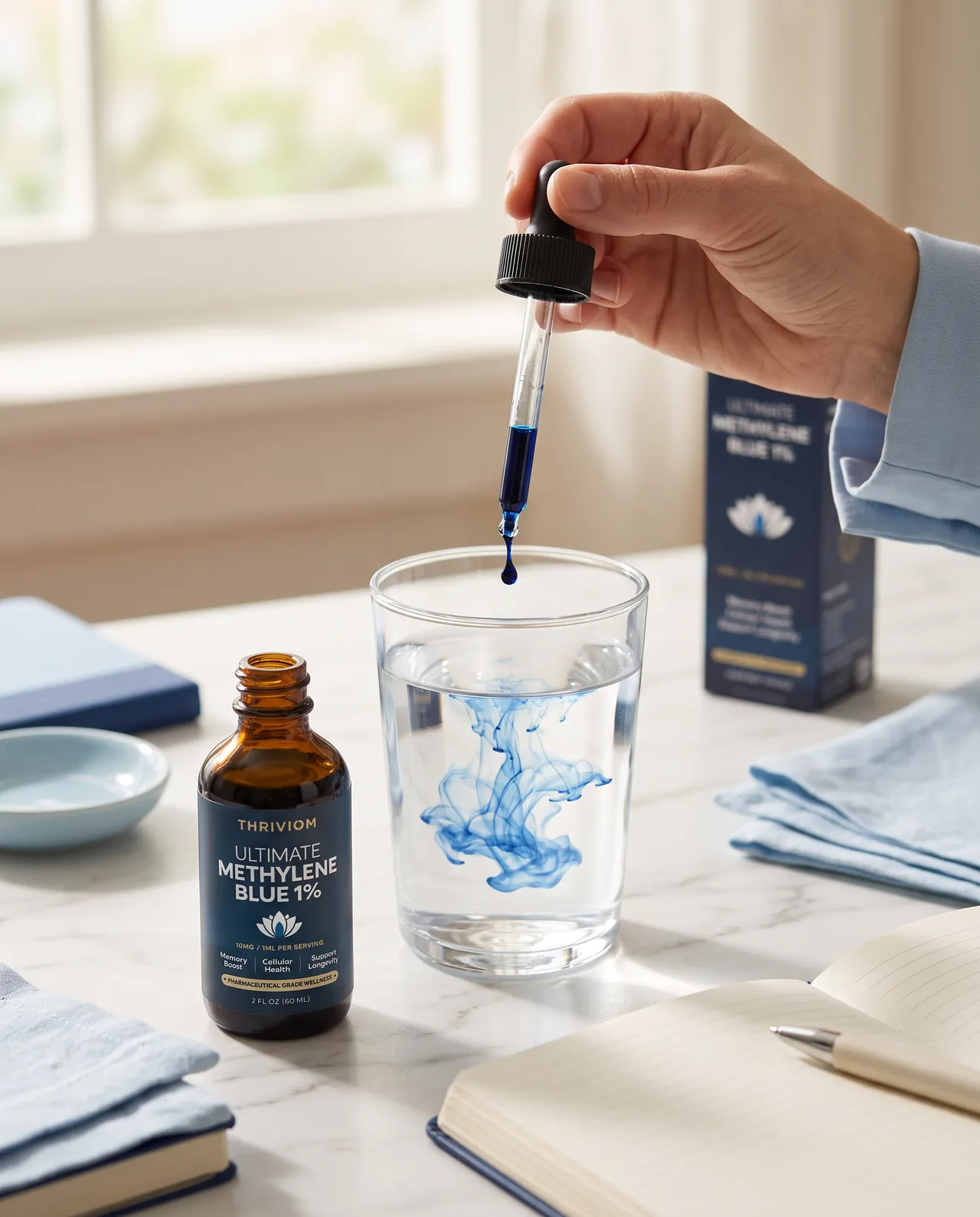
A dropper releasing a single drop of Thriviom Methylene Blue into a glass of water, the blue spreading through it

What it is, said plainly.

The level the day is decided at.

Mitochondria are where cells make their energy. When focus drifts and energy fades through the afternoon, that is the level the day is being decided at — not the stimulant level.

Cellular support, not a stimulant.

Methylene Blue 1% is positioned for mental clarity, energy and mitochondrial support. Plenty of people reach for it around the afternoon dip, which is where that framing comes from, but there is no required time of day.

It is not a stimulant.

It should not be expected to feel like one. It is also a strong blue dye: measure carefully, keep it off fabric, and expect the solution — and briefly your tongue — to be blue. It interacts with some medications, which is a conversation for your doctor.

What’s in Methylene Blue 1%.

  • 10 mg per servingOne dropper is 1 ml, and 1 ml is 10 mg of methylene blue. The amount is printed on the label, not hidden behind a blend.
  • A 1% solutionPharmaceutical grade, prepared at one percent. Strength is a fact about the liquid, which is why it is stated rather than described.
  • 60 servingsA 60 ml bottle, measured out by the dropper rather than guessed by eye. Sixty servings at one a day.
  • Nothing elsePure de-ionized water is the only other ingredient. No fillers, no flavoring, and no coloring beyond the compound itself.

What it isn’tIt is not a stimulant and should not be expected to feel like one. It is a strong blue dye, and it interacts with some medications — if you take any, or are pregnant or nursing, speak to your doctor first.

How to take it.

  1. 01

    Measure

    One dropper, 1 ml, 10 mg. The dropper is the measure — don't pour.

  2. 02

    Take it

    Morning or early afternoon suits most routines. There is no required time of day.

  3. 03

    Expect blue

    The solution is a dye. Briefly your tongue, and possibly your urine. Both pass, and both are harmless.

Questions about methylene blue.

Anything else, write to support@thriviom.com.
Take it as directed on the label. Morning or early afternoon suits most routines, and the afternoon dip is the moment it tends to be chosen for — but there’s no strict timing requirement, so the honest answer is: whenever you’ll actually remember to.

Methylene blue can interact with some medications. If you take any medication, are pregnant or nursing, or manage a health condition, check with your doctor before starting. This page doesn’t replace that conversation.

It can. Methylene blue may make urine or stool appear blue or green. It is a known, temporary and harmless effect, and it passes.

Methylene blue is a strong blue dye. Measure carefully, keep it off fabric and surfaces, and expect the solution — and briefly your tongue — to be blue.

Take it as directed on the label. As with any supplement, check with your doctor if you are on medication or managing a health condition.

Questions about methylene blue, answered.

Further reading

  1. U.S. Food and Drug Administration (label) PROVAYBLUE (methylene blue) injection, USP: Full Prescribing Information. Drugs@FDA, 2016.
  2. Zuschlag ZD, Warren MW, Schultz SK. Serotonin Toxicity and Urinary Analgesics: A Case Report and Systematic Literature Review of Methylene Blue-Induced Serotonin Syndrome. Psychosomatics, 2018.
  3. Bruchey AK, Gonzalez-Lima F. Behavioral, Physiological and Biochemical Hormetic Responses to the Autoxidizable Dye Methylene Blue. American Journal of Pharmacology and Toxicology, 2008.
  4. Rodriguez P, et al. Multimodal Randomized Functional MR Imaging of the Effects of Methylene Blue in the Human Brain. Radiology, 2016.
  5. Yang L, et al. Mitochondria as a target for neuroprotection: role of methylene blue and photobiomodulation. Translational Neurodegeneration, 2020.
  6. Schirmer RH, et al. “Lest we forget you — methylene blue…”. Neurobiology of Aging, 2011.

Keep reading.

These statements have not been evaluated by the Food and Drug Administration. These products are not intended to diagnose, treat, cure, or prevent any disease.